A psychology student practising a clinical interview on a laptop

UDIMA

How UDIMA brings AI virtual-patient practice to its whole Psychology and Speech Therapy faculty

AI Platform · Psychology & Speech Therapy

+1,000
students
+25
subjects
3
levels

The context

An entire faculty, not an isolated pilot

UDIMA — the Open University of Madrid (Universidad a Distancia de Madrid) — is one of the best-known names in distance higher education in Spain. Its programmes train students who, before they can practise, need to master something that books alone cannot teach: the clinical interview, the conversation with the patient.

Rather than testing AI conversational simulation in a single course, UDIMA brought it into the official curriculum at scale: more than 1,000 students, across over 25 subjects spanning the Psychology degree, the Speech Therapy degree, several official Master's programmes (among them General Health Psychology, child and adolescent psychology, and psychological trauma) and the Doctorate in Mental Health. It is not a pilot on the side, but a standard part of how its professionals are trained — from undergraduate to doctoral level.

The challenge

Clinical interviewing that doesn't scale

Training in clinical interviewing has always leaned on in-person role play: a classmate or an actor plays the patient while the student practises. It works, but it runs into a limit that is hard to get past — it doesn't scale.

  • Each session means coordinating schedules, rooms and people, so a student only practises a handful of times across the whole course.
  • Those rehearsals almost always feature the same small set of patient profiles.
  • There is no objective way to measure how the student actually did.
  • Across more than 1,000 students — many of them studying at a distance — multiplying that logistics simply becomes unworkable.

What we built

Unlimited, asynchronous, measurable practice

With the MetaMedicsVR AI Platform, UDIMA's students practise clinical interviews with AI virtual patients they can talk to out loud, just as they would with a real person. The patient responds in character; the conversation branches with what the student says. The same approach serves very different subjects — from assessment and diagnosis to interventions in trauma, child and adolescent psychology, work with victims, and speech-and-language evaluation.

What changes for the student

  • They practise as many times as they need, at any hour — a natural fit for UDIMA's distance model.
  • They face many different patient profiles, not just the ones a single actor can play.
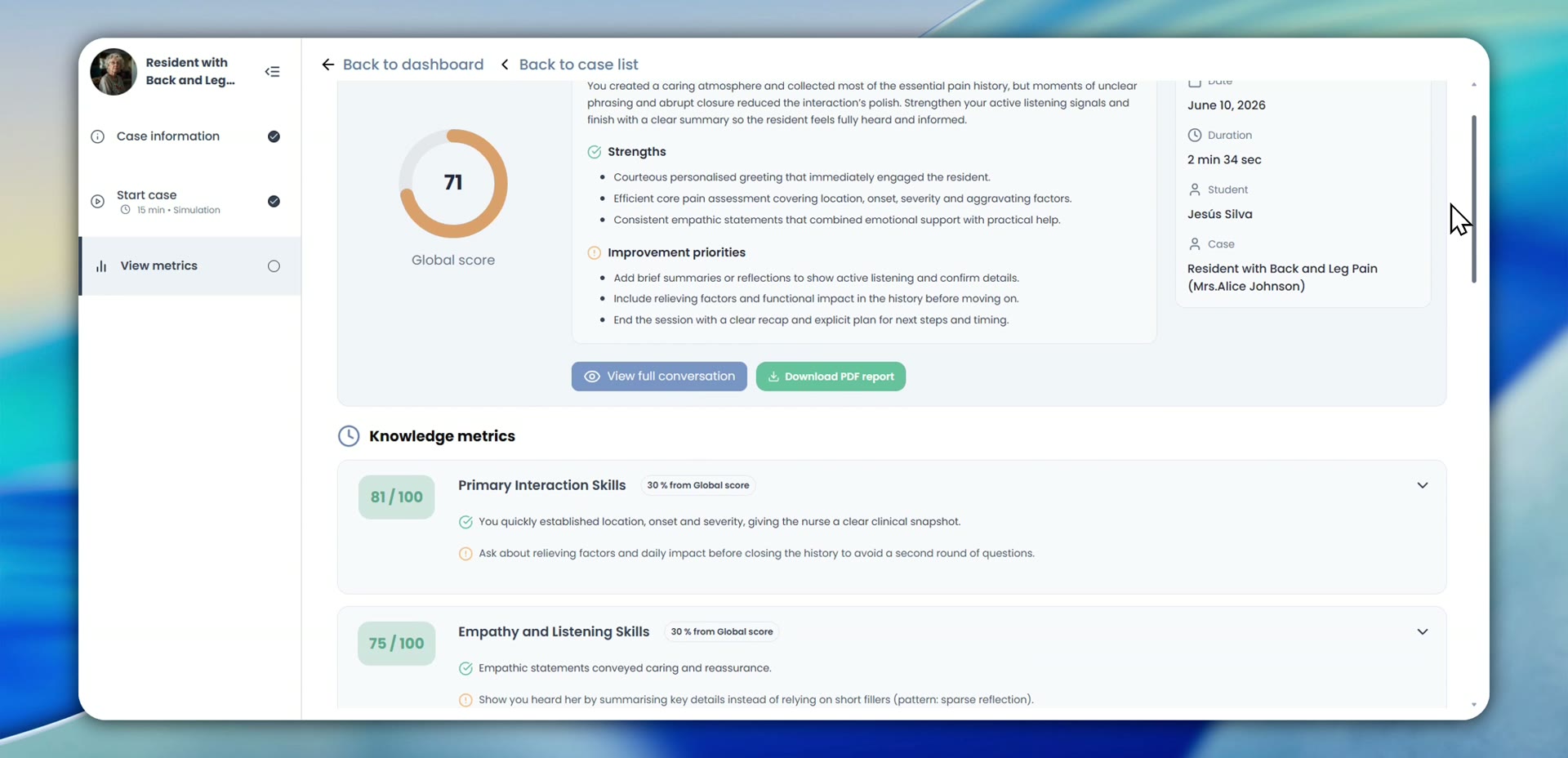
  • They get an objective, automatic assessment of each interview against a rubric.
  • The teaching staff define the cases and the rubric, so practice stays aligned with what each subject is meant to teach.

Why it matters

From a handful of rehearsals to deliberate practice

The shift is simple to describe and hard to overstate: clinical interviewing stops being something a student rehearses two or three times before an exam and becomes something they can practise deliberately, again and again, until it feels natural. No actors, no logistics, and — for the first time — with data the faculty can look at.

More than 1,000 students now train this way, across degree, Master's and doctoral programmes — a reach that simply was not possible when every rehearsal needed a room and an actor.

If you recognise your own situation here, let's talk about how it could work for you.

Back to case studies

GET STARTED

See what the next generation of healthcare training looks like.

Whether you run a faculty, a residency program, a clinical training department, or a continuing education operation — a 20-minute demo, tailored to your context, is the fastest way to know if this fits.

We'll get back to you within one business day. No spam. Privacy Policy