
CLINICAL DECISION CASES
Every decision leads somewhere. Students see exactly where — and why.
Branching clinical scenarios where every choice has consequences. Students work through real situations with incomplete information, competing priorities, and time pressure — the conditions under which clinical judgment is actually developed.
HOW IT WORKS
Not multiple choice. Decision trees with real consequences.
- 01
The case opens
A clinical case is presented — a patient, a setting, a set of initial findings.
- 02
The student decides
What to examine next, what diagnosis to pursue, what treatment to recommend.
- 03
The scenario branches
The case unfolds based on that choice. Each subsequent decision narrows or widens the path.
- 04
The full map
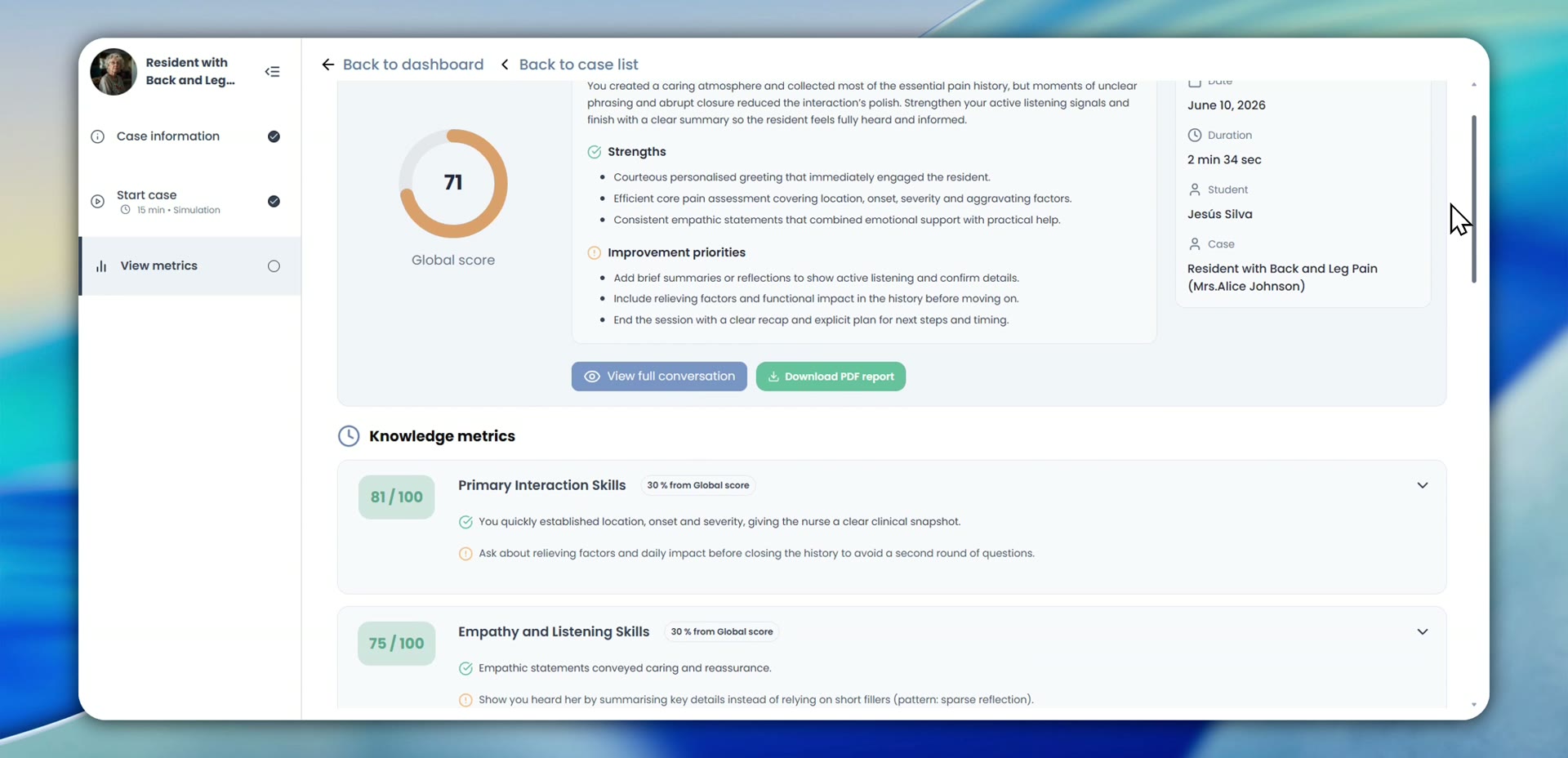
At the end, the student sees every choice they made — and the clinical logic behind each consequence.
THE FULL MAP
Every choice the student made — and the clinical logic behind each consequence.
Built by the educator. Reviewed branch by branch.
The educator builds the case from existing materials — clinical guidelines, real cases, or specialty protocols. The platform generates the branching structure. The educator reviews and adjusts every branch before students see it.
For every decision that determines the outcome.
- Differential diagnosis training
- Pharmacological decision-making
- Nursing priority and triage
- Ethics and end-of-life decisions
- Emergency medicine
- Any specialty where sequential decisions determine outcome
COMMON QUESTIONS
What educators ask about clinical decision cases.
-
What are clinical decision cases?
They are branching clinical scenarios in which every choice has consequences. Students work through real situations with incomplete information, competing priorities and time pressure, and each decision changes how the case unfolds.
-
How are they different from multiple-choice questions?
Instead of picking one answer, the student makes a sequence of decisions and the case branches after each one. At the end they see the full map of every choice they made and the clinical logic behind each consequence.
-
Who builds the branching cases?
The educator, starting from existing materials such as clinical guidelines, real cases or specialty protocols. The platform generates the branching structure, and the educator reviews and adjusts every branch before students see it.
-
Which specialties are they used for?
Differential diagnosis training, pharmacological decision-making, nursing priority and triage, ethics and end-of-life decisions, emergency medicine, and any specialty where sequential decisions determine the outcome.
ONE PLATFORM, SIX FORMATS
Explore the other formats.
From the blog
Keep exploring this topic.
 Health education
 Clinical judgment in nursing has six steps on the NCLEX
Since 2023 the NCLEX scores clinical judgment in six steps through unfolding cases. What each step asks, and how to teach it with a case that changes.
 Product
 Build your first clinical case in 15 minutes
You do not need to be a programmer to author a case in MetaMedicsVR. Here is the whole journey, from a blank page to a scenario your students can step into.
 Simulation & VR
 AI vs traditional clinical simulation: when each format wins
You have invested in manikins, actors, a simulation centre. Does AI make that obsolete? No — each format wins at something different. Here is an honest map of which to use when.
GET STARTED
See a branching clinical case built around your specialty in a demo.
Whether you run a faculty, a residency program, a clinical training department, or a continuing education operation — a 20-minute demo, tailored to your context, is the fastest way to know if this fits.
Thanks — we’ve got your request.
We’ll be in touch within one business day.