CONVERSATIONAL SIMULATOR
Practice the conversation. Not just the case.
Your students speak with a virtual patient — by voice or text. The patient responds the way a real one would. Every session is recorded, evaluated automatically, and ready for faculty review. The least practiced clinical skill becomes the most practiced one.



How should I assess a mole that’s recently changed?
THE STUDENT EXPERIENCE
What a session looks like from the student's side.
- 01
Enter the scenario
The student receives context: who the patient is, the clinical setting, and the objective of the conversation. No scripted prompts — they decide how to begin.
- 02
Speak or type
The student conducts the clinical interview by voice or text. The virtual patient responds naturally — with hesitations, partial information, emotional reactions, and the kind of ambiguity real patients present.
- 03
Immediate feedback
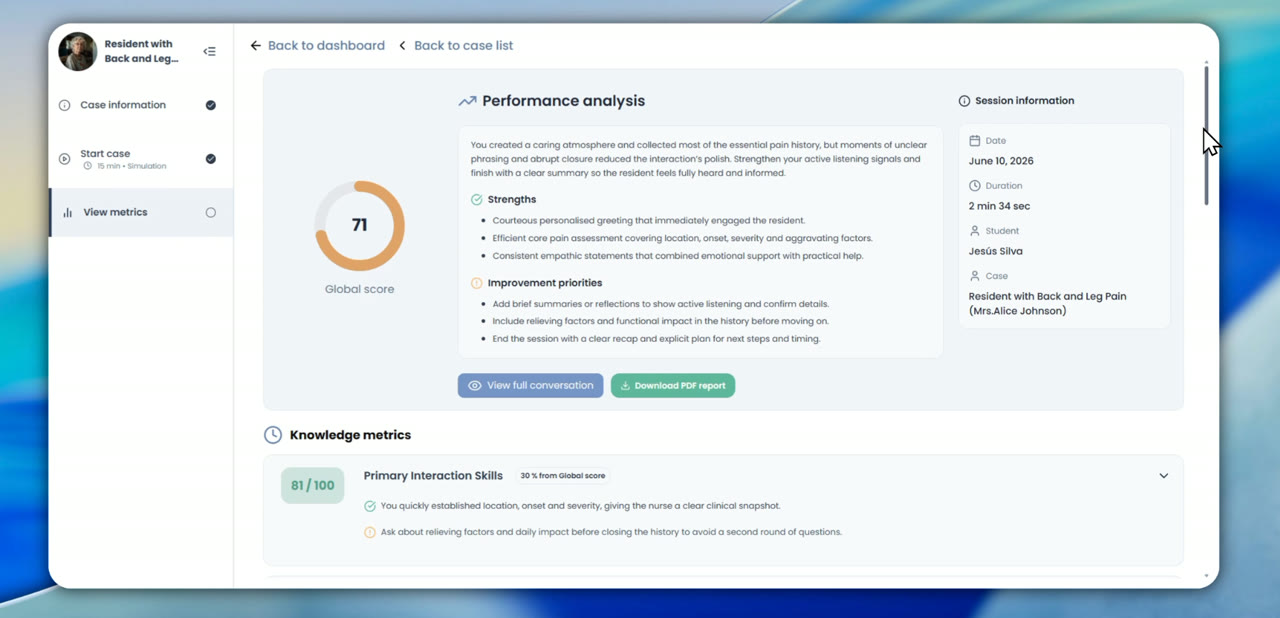
At the end of the session, the platform evaluates the conversation against the educator's rubric. The student sees what they did well, what they missed, and why — immediately, without waiting for faculty review.
- 04
Repeat
Same scenario, different approach. Or move to the next one. Students repeat as many times as they need, tracking their own progress across sessions.
THE EDUCATOR SIDE
Your clinical knowledge. Your patient. Your rubric.
The educator defines every aspect of the virtual patient: personality, emotional state, clinical history, and the specific objectives of the conversation. The platform builds the patient from those parameters. No programming, no technical setup.
The rubric is also defined by the educator — which competencies matter, how they're weighted, what constitutes a good response. The platform applies it automatically. The educator can review any session, listen to the recording, read the full transcript, and override any score.
For programs that want to start without building from scratch, MetaMedicsVR's pre-built patient library — developed with clinical partners and grounded in real patient data — is available from day one.
Evaluation rubric
4 sectionsPatient Communication
3 itemsEvaluates whether the student attends to the patient's account without interrupting and captures every concern.
Excellent (90-100): The student lets the patient finish their account, reflects back what they heard and gathers all concerns before moving on.
Good (70-89): The student listens to most of the account, though they occasionally interrupt or miss a secondary concern.
Evaluates whether the student adapts their language to the patient's level of understanding.
Excellent (90-100): The student explains the situation and next steps without technical jargon and checks that the patient has understood.
Good (70-89): The student is mostly clear, though some technical terms slip through without explanation.
Built for every conversation that matters.
- Clinical anamnesis and history-taking
- Therapeutic communication techniques
- Breaking bad news
- Verbal de-escalation and crisis management
- Therapeutic adherence and patient education
- Mental health assessment and clinical interview
- Suicide risk assessment
- Gender-based violence detection
- Cultural sensitivity and diverse patient populations
- Any situation where how you communicate matters as much as what you say
Every session. Every student. Full record.
- Faculty see individual performance across all competencies — with full transcripts and audio replay for every simulation.
- Cohort-level data shows where students consistently struggle, informing curriculum decisions.
- All data exports in formats compatible with accreditation reporting.
COMMON QUESTIONS
What educators ask about the conversational simulator.
-
What is a conversational simulator in healthcare education?
It is a simulation in which students hold a clinical conversation with a virtual patient, by voice or text, and the patient responds the way a real one would: with hesitations, partial information and emotional reactions. In the MetaMedicsVR AI Platform every session is recorded, transcribed and evaluated automatically against the educator's rubric.
-
Which communication skills can students practice?
Clinical history-taking, therapeutic communication techniques, breaking bad news, verbal de-escalation and crisis management, therapeutic adherence and patient education, mental health assessment, suicide risk assessment, gender-based violence detection and cultural sensitivity.
-
How is each conversation evaluated?
The educator defines the rubric: which competencies matter, how they are weighted and what a good response looks like. The platform applies it to every session and the student sees what they did well, what they missed and why. The educator can listen to the recording, read the full transcript and override any score.
-
Can students repeat a scenario?
Yes. Students can repeat the same scenario with a different approach as many times as they need, and track their own progress across sessions.
-
Does it require VR headsets or special hardware?
No. The Conversational Simulator runs in any browser, on any device. VR headsets are an optional add-on for specific immersive scenarios.
ONE PLATFORM, SIX FORMATS
Explore the other formats.
From the blog
Keep exploring this topic.
 Practical training
 Communication skills in healthcare that programs can grade
The five communication skills clinical work runs on, one behavior to grade in each, and where this blog goes deeper on every one of them.
 Practical training
 Suicide prevention training in hospitals, unit by unit
What each hospital unit tends to see, how to ask about suicidal thoughts plainly, and how a safety plan is built, drawn from the clinical guidelines.
 Practical training
 Therapeutic communication techniques: what they sound like, and how to practice them
Four therapeutic communication techniques with the exact words each one sounds like, three moments where the reflex reply fails, and where students rehearse them.
GET STARTED
See a live conversation with a virtual patient in 20 minutes.
We'll run a scenario relevant to your subject area — not a generic one.
Thanks — we’ve got your request.
We’ll be in touch within one business day.