01
Practice doesn't scale with your cohort.
Simulation labs and standardized patients work — for the students who get a slot. Most don’t practice enough before their first real clinical encounter.
For Universities & Faculties
Your faculty builds the scenarios. Your students practice on any device, as many times as they need. Your institution gets automatic assessment data — without adding load to anyone's workload.
Used by health sciences faculties at








The challenge
Watching, scoring, and giving feedback on every student's clinical performance is unsustainable at scale. Most programs end up evaluating less than they should.
Funders, accreditors, and prospective students want evidence of pedagogical innovation — not just a commitment to it. You need outcomes, not intentions.
What your faculty gets
Any scenario, any number of times, on any device. No lab bookings, no scheduling conflicts, no cost per additional session.

Choose from MetaMedicsVR's validated clinical rubric library or define your own. Every interaction is scored automatically — faculty review and override whenever needed.
Individual and cohort performance dashboards, exportable reports, and documented clinical contact hours in the format your accreditation process requires.
Everything stays inside the infrastructure your institution already runs. No new platforms, no parallel gradebooks.
Every pilot generates data. We help you structure it for grant applications, conference presentations, and peer-reviewed publications.
By discipline
From foundational history-taking to advanced diagnostic and procedural scenarios. The platform gives medicine students a space to practice the decisions they'll face in clinical rotations — under the uncertainty, time pressure, and ambiguity that a classroom can't replicate.
What students practice
Nursing simulation that covers clinical assessment, procedural reasoning, and the relational skills that define care quality — from patient interaction and escalation decisions to rehabilitation adherence and discharge planning.
What students practice
Developing the capacity to structure a clinical interview, manage emotional dynamics, and apply therapeutic techniques under pressure requires repeated practice in realistic scenarios — not role plays with peers.
What students practice
Most used formats
From foundational history-taking to advanced diagnostic and procedural scenarios. The platform gives medicine students a space to practice the decisions they'll face in clinical rotations — under the uncertainty, time pressure, and ambiguity that a classroom can't replicate.
What students practice
Most used formats
Nursing simulation that covers clinical assessment, procedural reasoning, and the relational skills that define care quality — from patient interaction and escalation decisions to rehabilitation adherence and discharge planning.
What students practice
Most used formats
Developing the capacity to structure a clinical interview, manage emotional dynamics, and apply therapeutic techniques under pressure requires repeated practice in realistic scenarios — not role plays with peers.
What students practice
Most used formats
What changes
Practice depends on lab slots. Most students get one or two before rotations.
Unlimited practice on any device. Every student arrives at rotations rehearsed.
Faculty spends hours scoring clinical performance manually — and it still misses students.
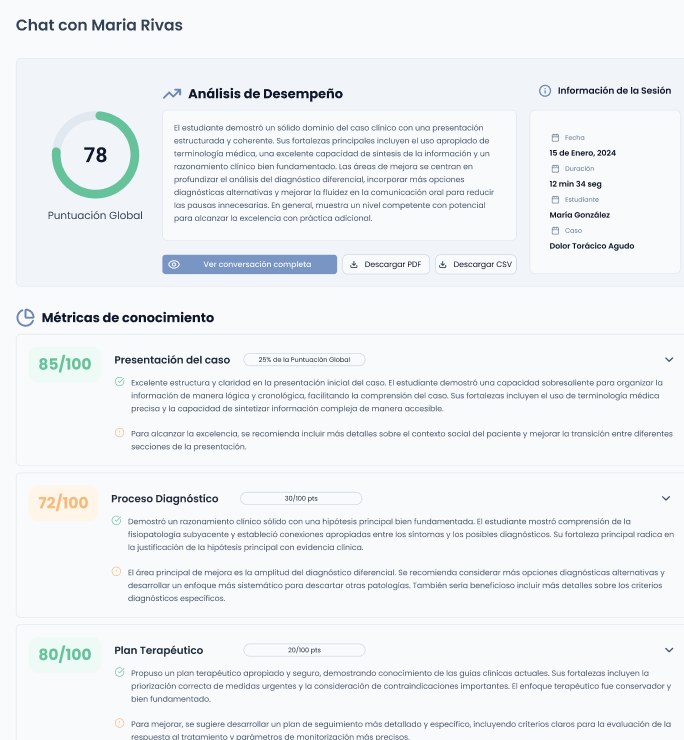
Every interaction scored automatically against your rubric. Faculty reviews and overrides where it matters.
Feedback reaches the student weeks after the encounter, when the learning moment is gone.
Immediate feedback after every attempt — students iterate within the same study session.
Accreditation reports are a manual scramble at the end of every semester.
Performance dashboards and accreditation-ready exports — always on, always current.
Innovation is anecdotal. Hard to defend in grants, harder to publish.
Every pilot generates structured data — ready for grant applications and peer-reviewed papers.
In practice
For universities & faculties · Free guide
Free: the Education 4.0 Guide
Higher education in the post-ChatGPT era — the methodologies that work and how to use AI as the answer.
From the blog
 Health education
 Headset, screen or manikin. What each one trains better, what the trials actually found, and how to pick without buying fifteen headsets first.
 Practical training
 Therapeutic communication in nursing, case by case: what to say to the patient who won’t talk, the family who answers for him, and the angry one, with the words.
 Health education
 In a 2025 survey, 92% of the nursing students polled used AI. What it does in nursing, whether it replaces nurses, and which parts of training it changes.
Get started
A 20-minute demo tailored to your faculty, your discipline, and the rubric your accreditation process expects. We will get back to you within one business day.
Thanks — we’ve got your request.
We’ll be in touch within one business day.