
VR Simulation
Human anatomy you can hold, rotate, and explore in your own hands.
A complete interactive 3D human body in VR. Students explore with their own hands. Multi-language, simple to use from day one, and built for both individual study and classroom teaching.
Through the lens
See the human body exactly as students hold it.
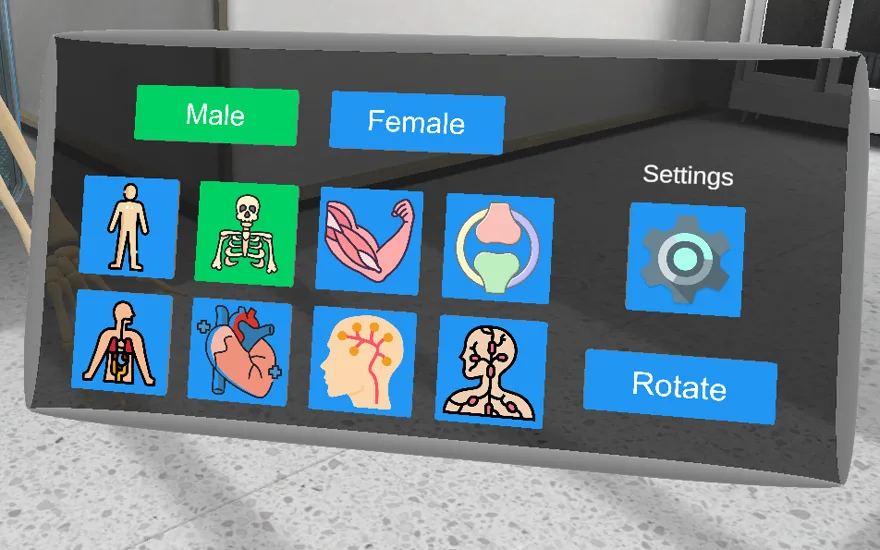
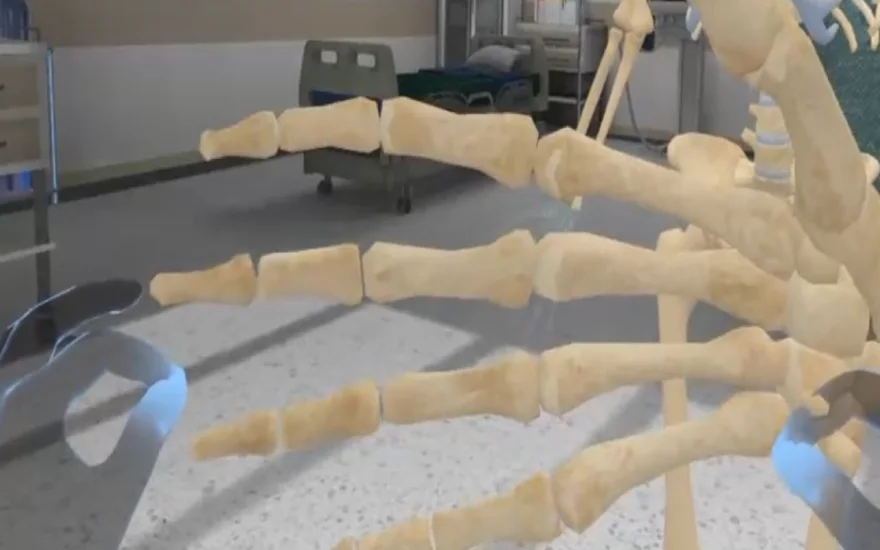
This is the interactive 3D body running on the headset. Students pick up structures, rotate them, and explore each system with their own hands.
- Hold & rotate
- Isolate a system
- Label structures
POV capture — Human Anatomy simulation.
Systems in 3D
Every system, picked up and explored from any angle.
Skeletal system
Students take the full skeleton in their hands, rotate it, and move around it to study how the bones fit together.
Muscular system
Layer by layer, they isolate the muscles — following each group and how it sits over the structures beneath.
Cardiovascular system
They hold the heart and the main vessels up close, separating each structure to see how the system connects.
What makes it different
-
Hand tracking — fully controller-free
Pick up, rotate, dissect, and annotate anatomical structures with your bare hands. No controllers to learn, no barriers between the student and the model.
-
Multi-language
Sessions run in the learner's language. Instructions, labels, and annotations switch automatically. Ideal for international programs and diverse cohorts.
-
Simple from day one
Designed for students and instructors who are new to VR. Intuitive interactions, clear onboarding, and no technical setup required on the instructor's side.
-
Classroom projection mode
The instructor projects what students see to a shared screen — for guided exploration, group discussion, and structured teaching sessions.
How a session runs
Every session follows the same loop — explore, isolate, label, review.
From exploring the whole body to reviewing as a class, students run the full sequence as many times as they need.
- 01
Explore
Pick up the body
Students grab the 3D body with their own hands, rotate it, and move freely around each region to get their bearings.
- 02
Isolate
Open a single system
They isolate one system — skeletal, muscular, cardiovascular, nervous, or another — and dissect it to study each structure on its own.
- 03
Label
Annotate the structures
Students name and label structures, while the instructor adds guided annotations to focus attention where it matters.
- 04
Review
Explore together in class
The instructor projects the view to a shared screen so the whole group explores, discusses, and reviews the same anatomy together.
What it covers
Complete skeletal and muscular system
Students isolate the skeleton and musculature, rotate individual bones and muscle groups, and study how the structures fit together layer by layer.
Cardiovascular and respiratory systems
Explore the heart, lungs, and the main vessels and airways in 3D, separating each structure to see how the systems connect.
Nervous system and brain anatomy
Examine the brain and nervous pathways in the round, isolating regions and structures to study them from any angle.
Digestive and urinary systems
Follow the digestive and urinary tracts through the body, pulling apart each organ to inspect it on its own.
Reproductive anatomy
Study the reproductive structures in 3D, with the same hands-on exploration and isolation as every other system.
Instructor-guided annotation and labelling
Instructors add annotations and labels to any structure, guiding students to exactly what they need to identify and learn.
Group exploration mode for classroom use
Project the view to a shared screen so the whole class explores the same body together, led by the instructor.
Who it's for
- Medicine and nursing programs
- Physiotherapy and occupational therapy
- Health sciences vocational programs
- Secondary and pre-university biology
- Anatomy and physiology (A&P) courses
Common questions
What programs ask about human anatomy in VR.
-
How does VR anatomy work in a classroom?
Each student explores the interactive 3D body on a standalone headset while the instructor projects their view to a shared screen — so the whole group explores, discusses, and reviews the same anatomy together. It works both for individual study and for structured, instructor-led sessions.
-
Which anatomical systems does the simulation cover?
The complete skeletal and muscular systems, the cardiovascular and respiratory systems, the nervous system and brain anatomy, the digestive and urinary tracts, and reproductive anatomy. Every structure can be picked up, rotated, isolated, and labeled.
-
Do students need VR experience or controllers?
No. The simulation runs on standalone headsets with hand tracking — students pick up and dissect structures with their bare hands, with no controllers to learn. It is designed for students and instructors who are new to VR, and there is no technical setup on the instructor’s side.
-
Does VR replace the anatomy atlas or the dissection lab?
It complements them. What VR adds is manipulation and unlimited repetition: students hold structures in their own hands, isolate one system at a time, and repeat the sequence as often as they need — alongside the atlas, models, and lab sessions the program already uses.
-
What languages does it support?
Sessions run in the learner’s language — instructions, labels, and annotations switch automatically. English and Spanish are available today, which makes it a fit for international programs and diverse cohorts.
-
Can it be used for an anatomy and physiology (A&P) course?
Yes. It covers the systems an A&P course works through: skeletal and muscular, cardiovascular and respiratory, nervous, digestive and urinary, and reproductive. Every structure can be isolated, rotated, and labeled. Instructors run it as a whole-class session with the view projected to a shared screen, or set it for individual study between lectures and lab sessions.
From the blog
Keep exploring this topic.
 Simulation & VR
 Human anatomy in VR: what changes when students can hold the body
Anatomy is a three-dimensional subject that most students still learn from flat images. In VR, the body becomes something you hold, rotate and take apart with your own hands — as many times as you need.
 Health education
 VR in healthcare training: what it is good at, and what to use when it is not
Headset, screen or manikin. What each one trains better, what the trials actually found, and how to pick without buying fifteen headsets first.
 Health education
 Learning by doing in healthcare: from methodology to measurable outcomes
"Learning by doing" sounds right, but accreditors ask for outcomes, not slogans. This is how to tie the methodology to evidence you can actually defend.
GET STARTED
See the full body in your hands — in a demo.
Multi-language, controller-free, and ready for your classroom from day one. Let us show you what that looks like for your program.
Thanks — we’ve got your request.
We’ll be in touch within one business day.