WS1 slides
Slide deck — Gender stereotypes and the care gender gap.
Lithuanian version by Social Innovation Fund, editable PowerPoint. Spanish and Polish versions coming soon.
A complete collection of educational materials developed for the VR Balance project — from leadership guides and workshop activity sheets to promotional posters and registration materials.
The complete, step-by-step guide to replicating the VR Balance course anywhere: the pedagogical model, the three workshops with their materials, the VR session, the short online version, evaluation instruments and the results of the original project.
Download the handbook (PDF)Version 2.2 · September 2026 · English · Free to use and adapt for non-commercial educational purposes with attribution.
Every material is named exactly as cited in the handbook. The English files and the Lithuanian slides and card decks are available now; the Spanish and Polish versions are being added. If you need a version not yet listed, request it at beatriz@metamedicsvr.com.
Slide deck — Gender stereotypes and the care gender gap.
Lithuanian version by Social Innovation Fund, editable PowerPoint. Spanish and Polish versions coming soon.
Facilitator script — what to explain on each slide of WS1.
Editable Word file. Spanish, Polish and Lithuanian versions coming soon.
Cards activity 1 — rewriting and reformulating stereotypical phrases (printable).
Polish version coming soon.
Blank cards for phase 3 (reframing a phrase) and for the personal action card of phase 4.
Slide deck — Gender discrimination at the workplace: consequences of the gender career gap and causes of economic inequality.
Lithuanian version by Social Innovation Fund, editable PowerPoint. Spanish and Polish versions coming soon.
Facilitator script — what to explain on each slide of WS2.
Editable Word file. Spanish, Polish and Lithuanian versions coming soon.
Cards activity 2 — character & stereotype cards: influential women and gender-diverse figures (printable).
English and Polish card decks coming soon.
Introduction to the immersive experience — orientation, safety and purpose.
The Lithuanian file is the full Workshop 3 deck, not only the introduction. Spanish and Polish versions coming soon.
Facilitator script for the VR session — orientation, rotation and final debriefing.
Files coming soon.
Final seminar activity — the six scenarios revisited one by one: all 23 in-experience questions with their options and explanations, plus the discussion keys for the closing debriefing.
Questions and explanations are the exact texts of the experience; discussion keys by the University of Barcelona team. Polish and Lithuanian versions coming soon.
The six scenarios for Meta Quest 3 headsets and the computer (desktop) version — EN, ES, CA, LT, PL.
vrbalance.metamedicsvr.com ↗Video recordings of the six scenarios, ready to screen — five languages.
Watch on YouTube ↗Online readings participants complete on their own devices — EN, ES, LT, PL.
godigital.lmlo.lt ↗Everything else a replicating institution needs, as used in the original courses: the evaluation instruments, the materials of the 90-minute online version, the organisation templates and the dissemination kit. Cited in the handbook, Sections 10–12 and Appendix A.
The full pre-survey and post-survey used in the course: participant profile, the MuGIPS scale, perceptions of stereotypes, discrimination and the career gap, and the satisfaction survey. Editable, to load into any GDPR-compliant survey tool.
Handbook, Section 12. Keep responses anonymous and ask for consent if you will use the data for research.
The 25 items of the Multidimensional Gender Inequality Perception Scale, the validated instrument at the heart of the pre/post comparison, in English and Spanish.
Scale by Schwartz-Salazar, García-Sánchez, Martínez & Rodríguez-Bailón (2024), PLOS ONE: doi.org/10.1371/journal.pone.0301755. Cite the authors if you use it.
The 90-minute online version of the course: the facilitator script, the slide deck used in the Spanish event and the questionnaire on the six scenarios used as the session's pre/post check.
Handbook, Section 10. The script is in English; the slides and the questionnaire are the Spanish originals.
The agenda handed to participants at the University of Barcelona course day (29 January 2026): arrival and kit pick-up, the two workshops, the VR experience in rotation and the closing.
Handbook, Sections 6 and 11. Use it as the model for your own timetable.
A 16:9 slide template in the project identity for speakers and facilitators: cover, section, content, two-column, image, key-figure, quote and closing slides, with the EU emblem and the project reference on every slide.
Typeface Poppins (built into Google Slides; free on Google Fonts). Keep the footer: it is a visibility obligation of the grant.
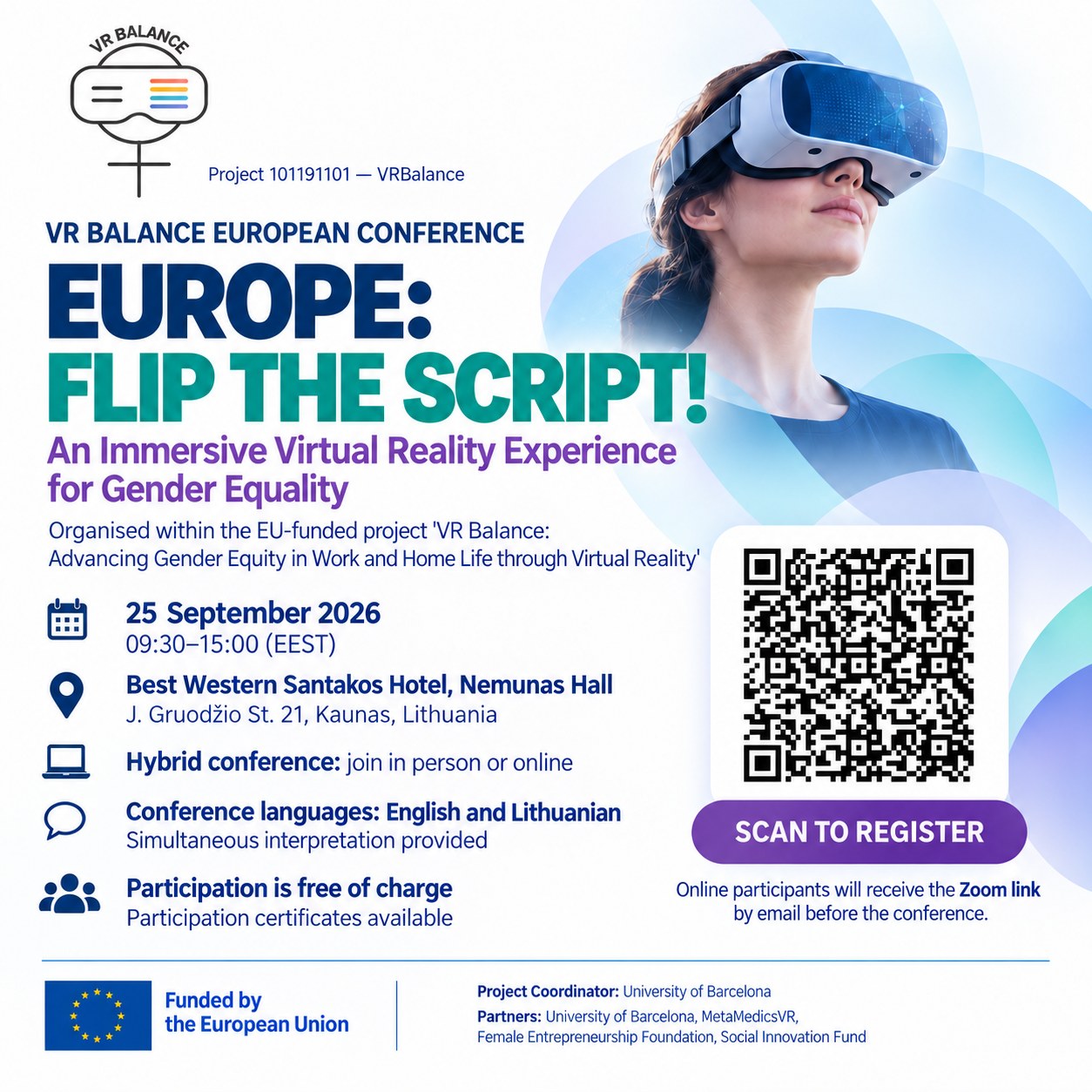
The official invitation to Europe: Flip the Script!, the VR Balance European Conference in Kaunas on 25 September 2026 — programme highlights, venue, languages and the registration QR code. Share it with your networks.
Hybrid, free of charge, English and Lithuanian with simultaneous interpretation. Registration form.
The MetaMedicsVR talk at the European Conference: why empathy cannot be taught with slides, what changes when you live a situation from the inside, and how virtual reality and conversational AI turn that feeling into a skill. Built on the project template, speaker notes included.
Beatriz Zambrano Serrano · Kaunas, 25 September 2026. Figures sourced from the handbook and the project deliverables.
The three press-style “hits” with their ready-to-post versions, the matching social-media images by hit and language, Poster 1 in five languages and the consortium's posting calendar as a planning example.
EN, ES, CA, LT, PL. Images 1080 × 1350 px. Free to adapt with attribution.
The communications accepted at the 9th International Health Sciences Congress (July 2026) and the journal article under review, with their abstracts.
See the publications ↗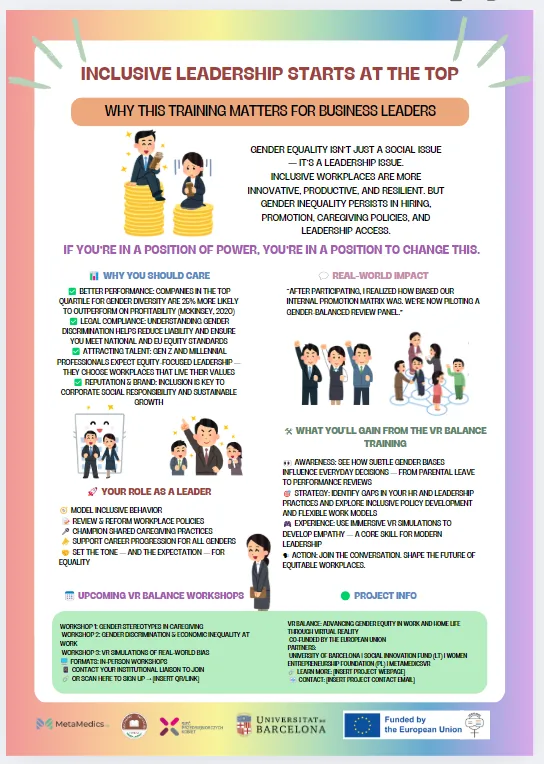
An essential guide for executives. Discover why gender equality improves profitability, reduces legal risks, and attracts young talent. Includes HR strategies and internal promotion matrices.
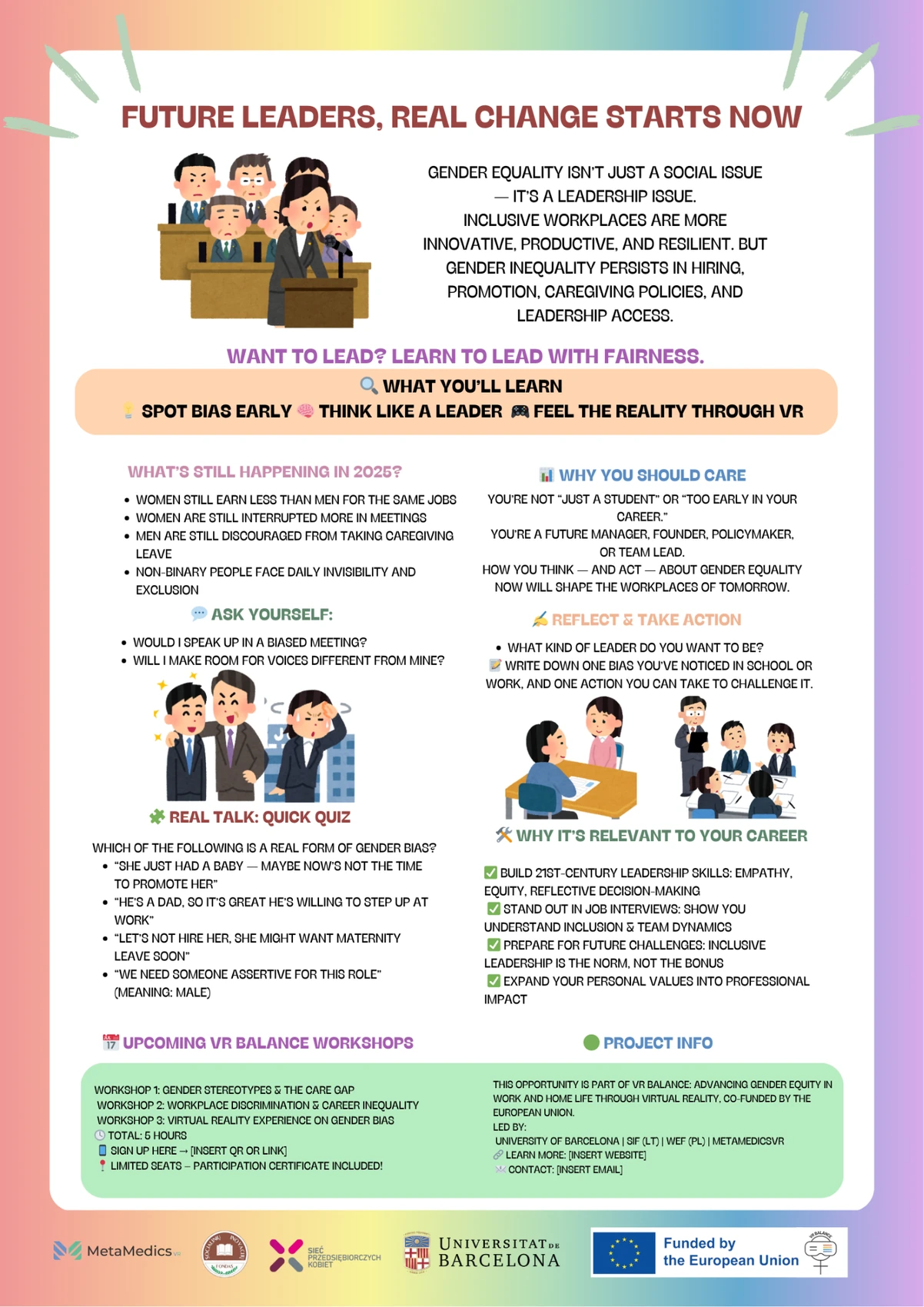
Focused on students and future managers. Learn to detect early bias, develop empathy through VR, and prepare for inclusive job interviews and modern leadership challenges.
The three folded leaflets, one per workshop, as print files (A4 landscape, two sides):
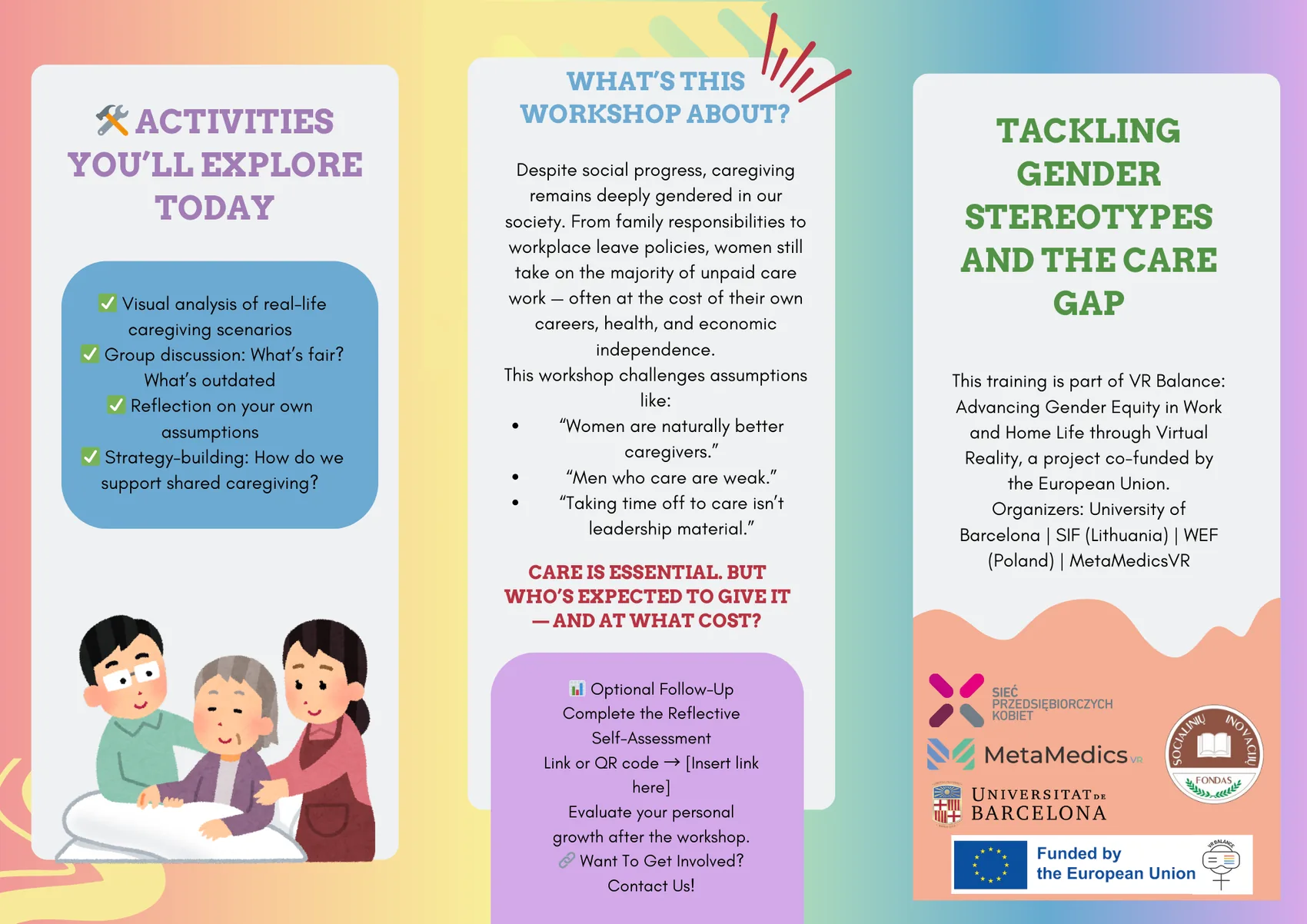
Visual analysis of caregiving scenarios, group discussions on "what is fair," and building strategies to share responsibilities at home.
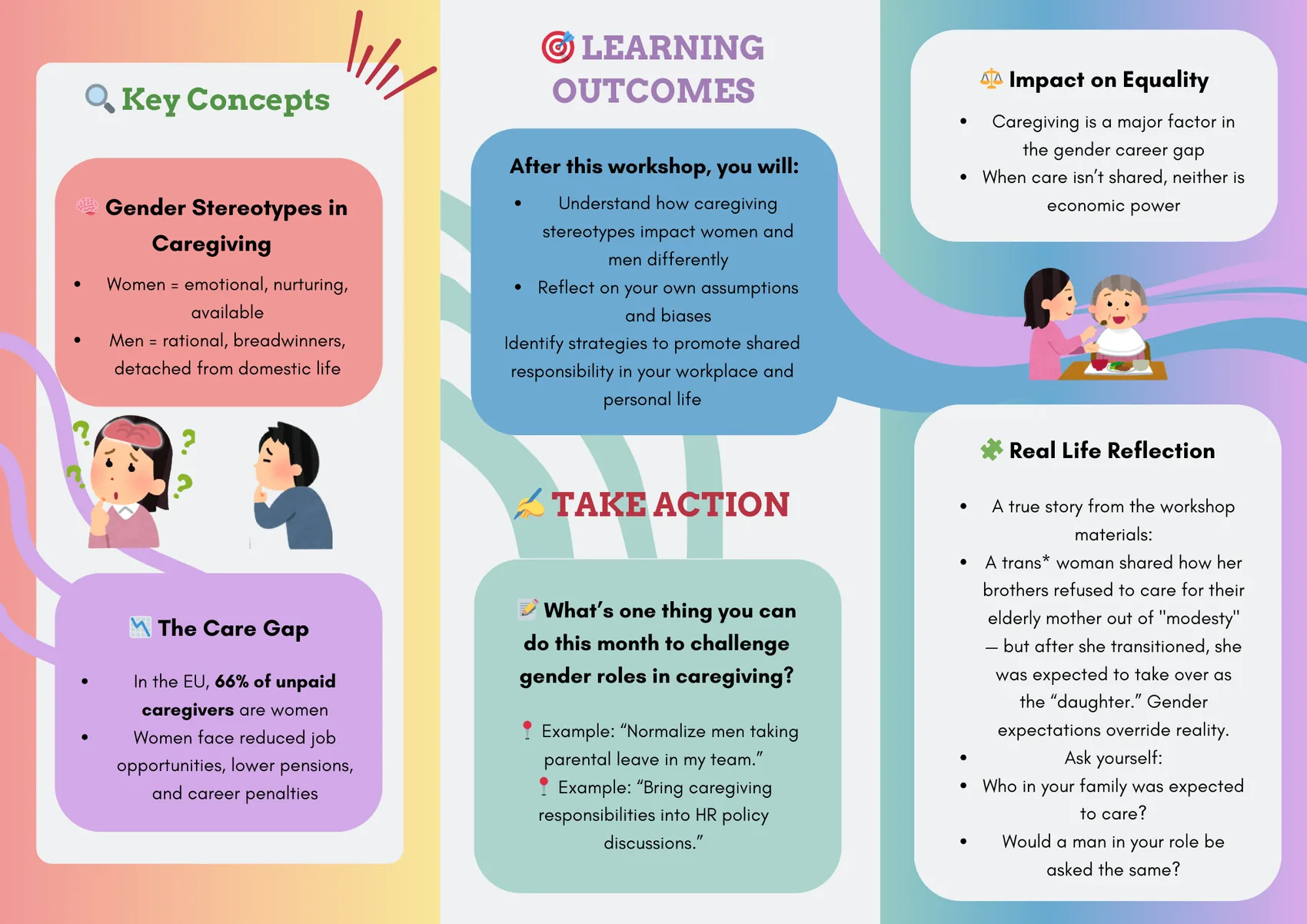
Visual summary of gender stereotypes, EU data showing 66% of unpaid caregivers are women, and the impact on equality.
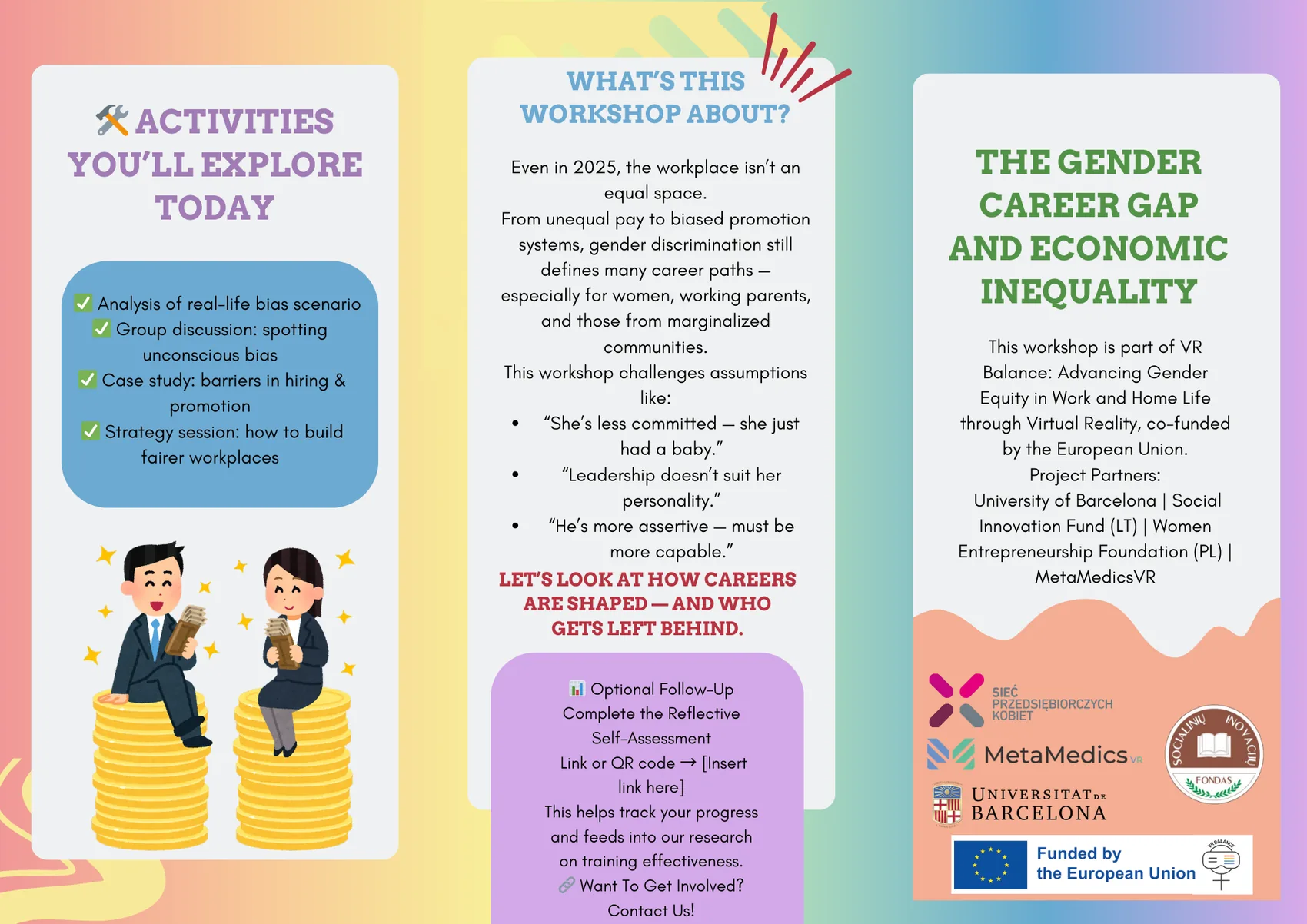
Dynamics to detect unconscious bias, identify barriers in hiring processes, and strategy sessions to create fairer workplaces.
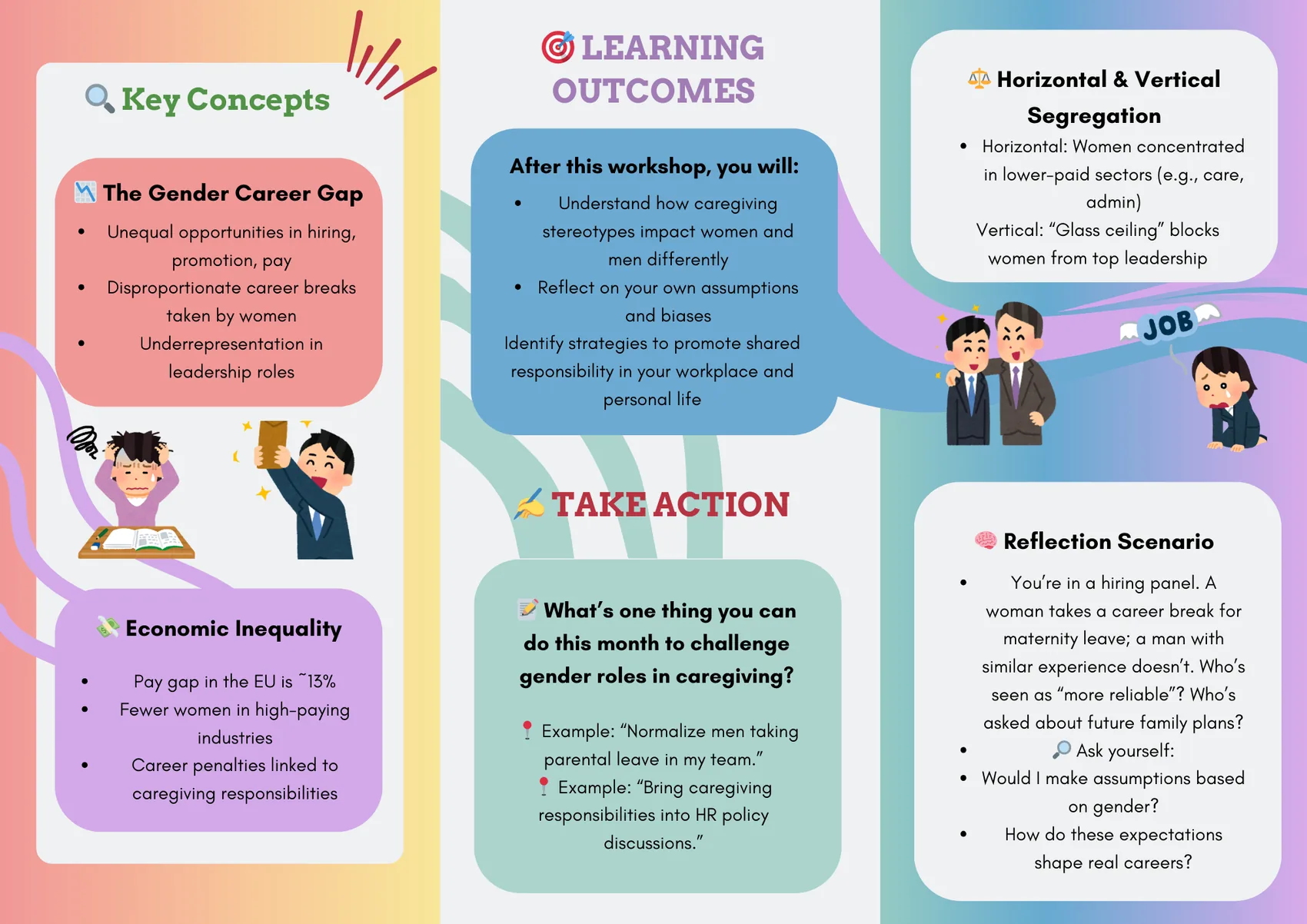
Graphic explanation of horizontal and vertical segregation, the 13% gender pay gap, and career penalties for women.
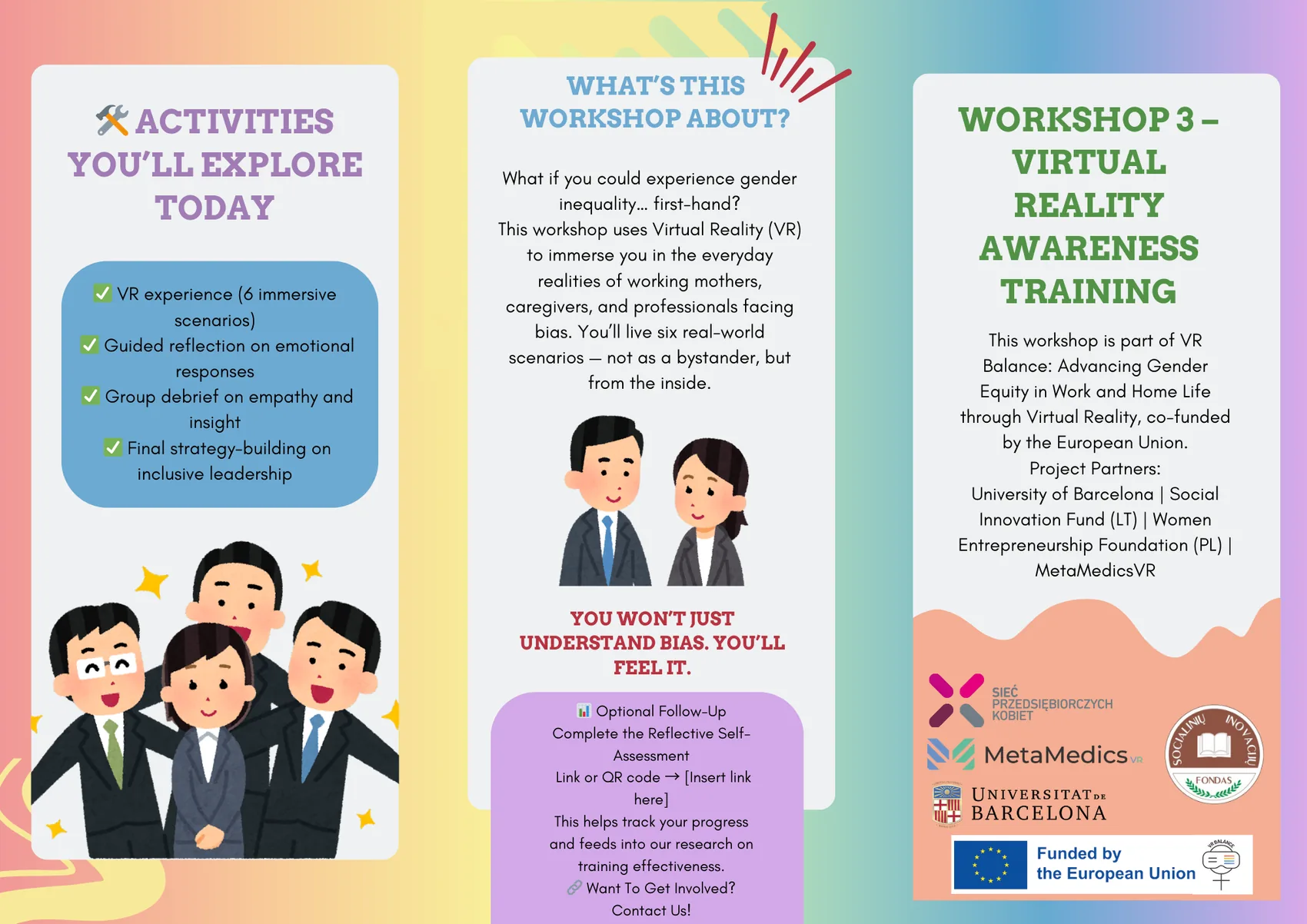
Description of the 6 immersive experiences, guided reflection on emotional responses, and building empathetic leadership skills.
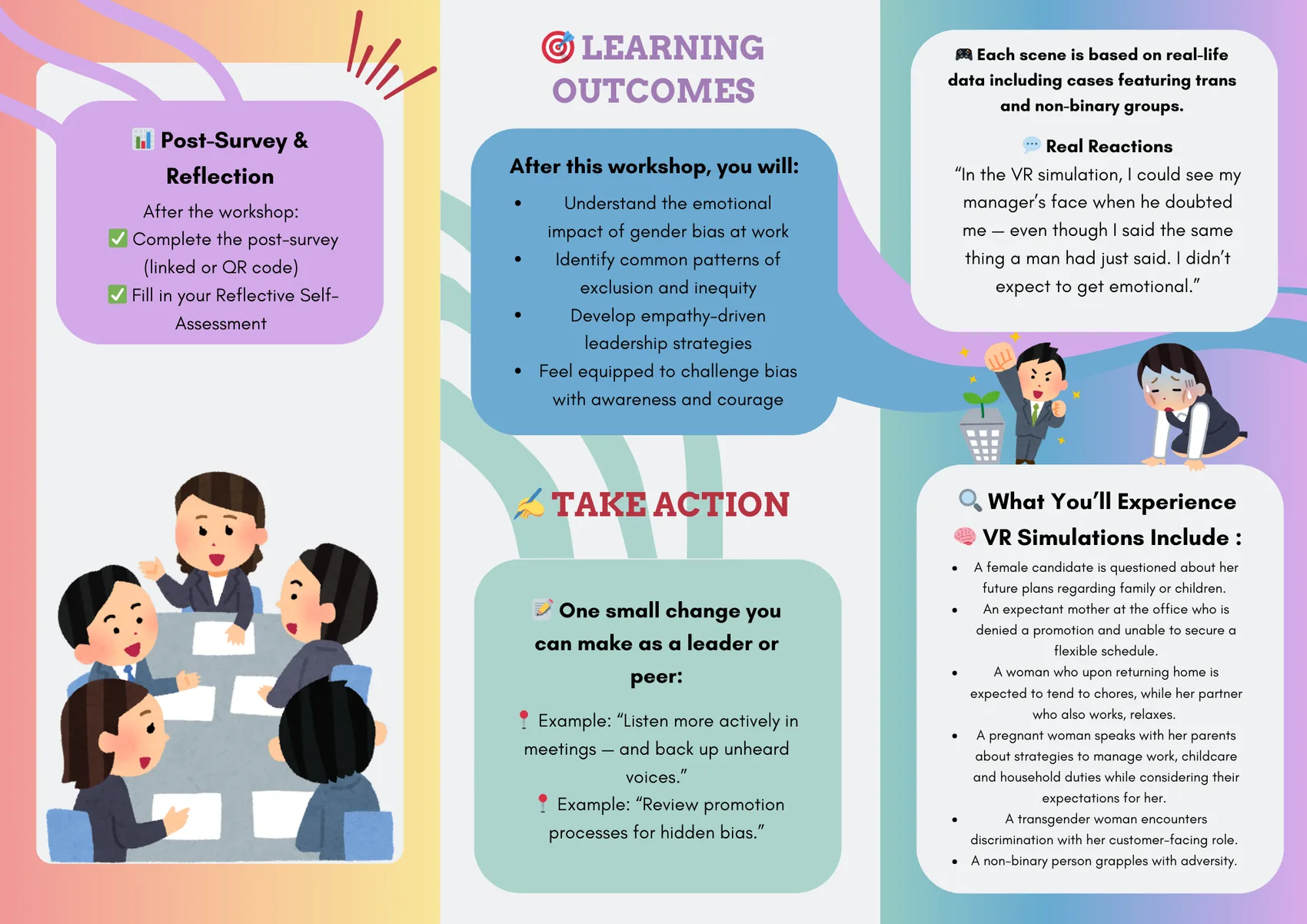
Expected outcomes: understanding the emotional impact of bias, identifying exclusion patterns, and challenging discrimination.
The three recruitment posters as print files (A2, with a blank space for your registration QR code), and Poster 1 in the five languages of the project.
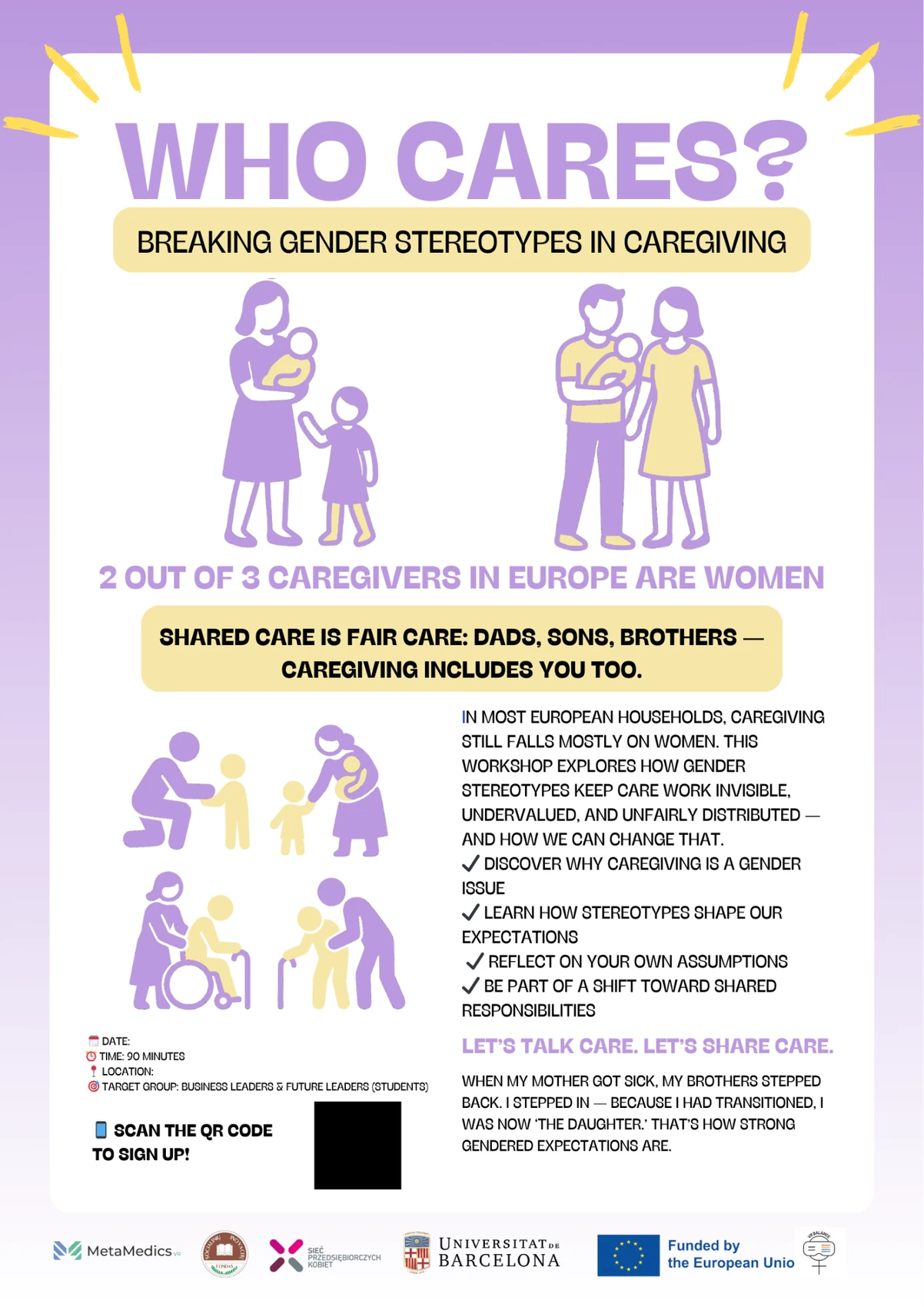
In most European households, caregiving still falls mostly on women. This workshop explores how gender stereotypes keep care work invisible, undervalued, and unfairly distributed.
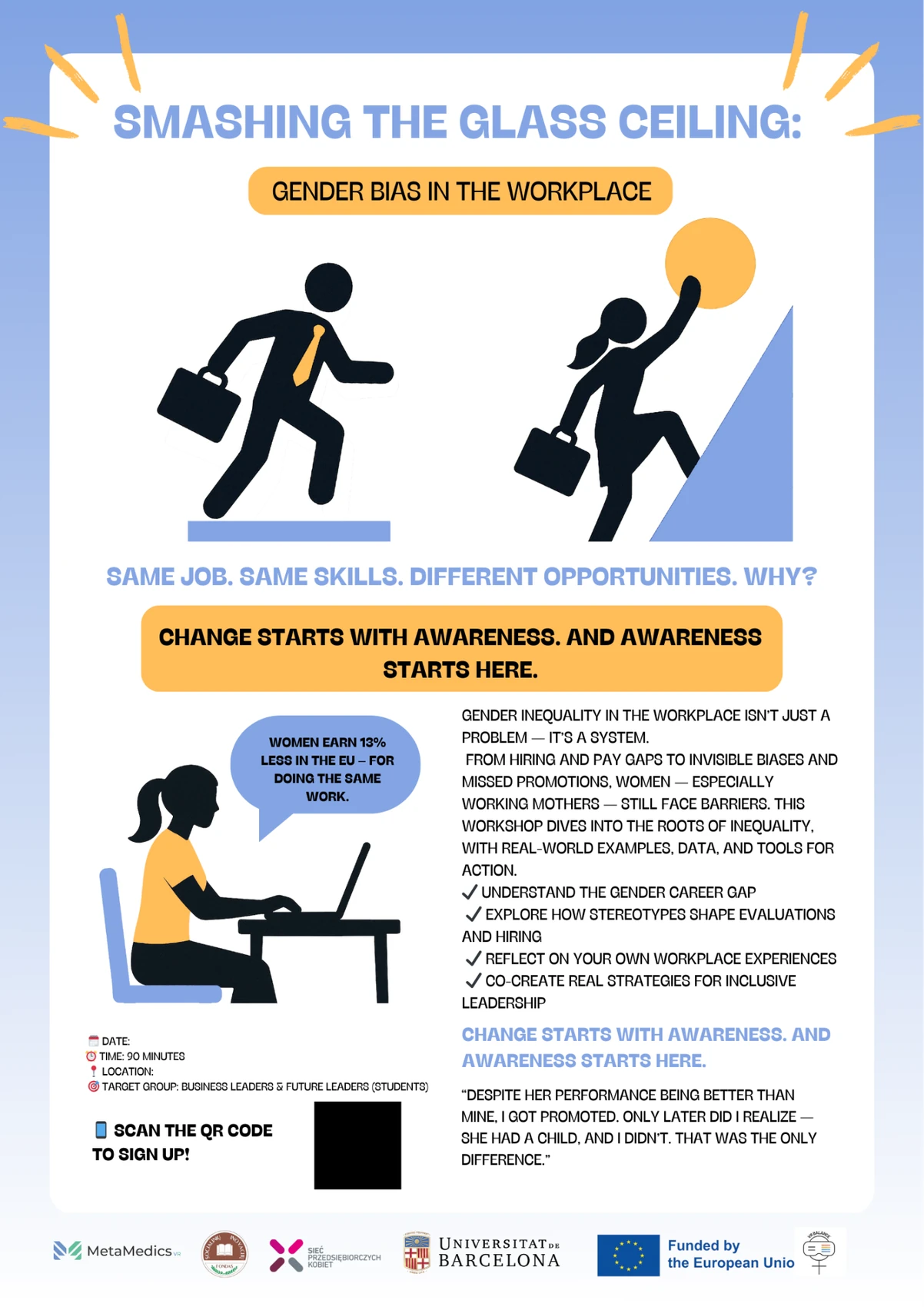
Gender inequality in the workplace isn't just a problem — it's a system. From hiring and pay gaps to invisible biases and missed promotions, women still face barriers.
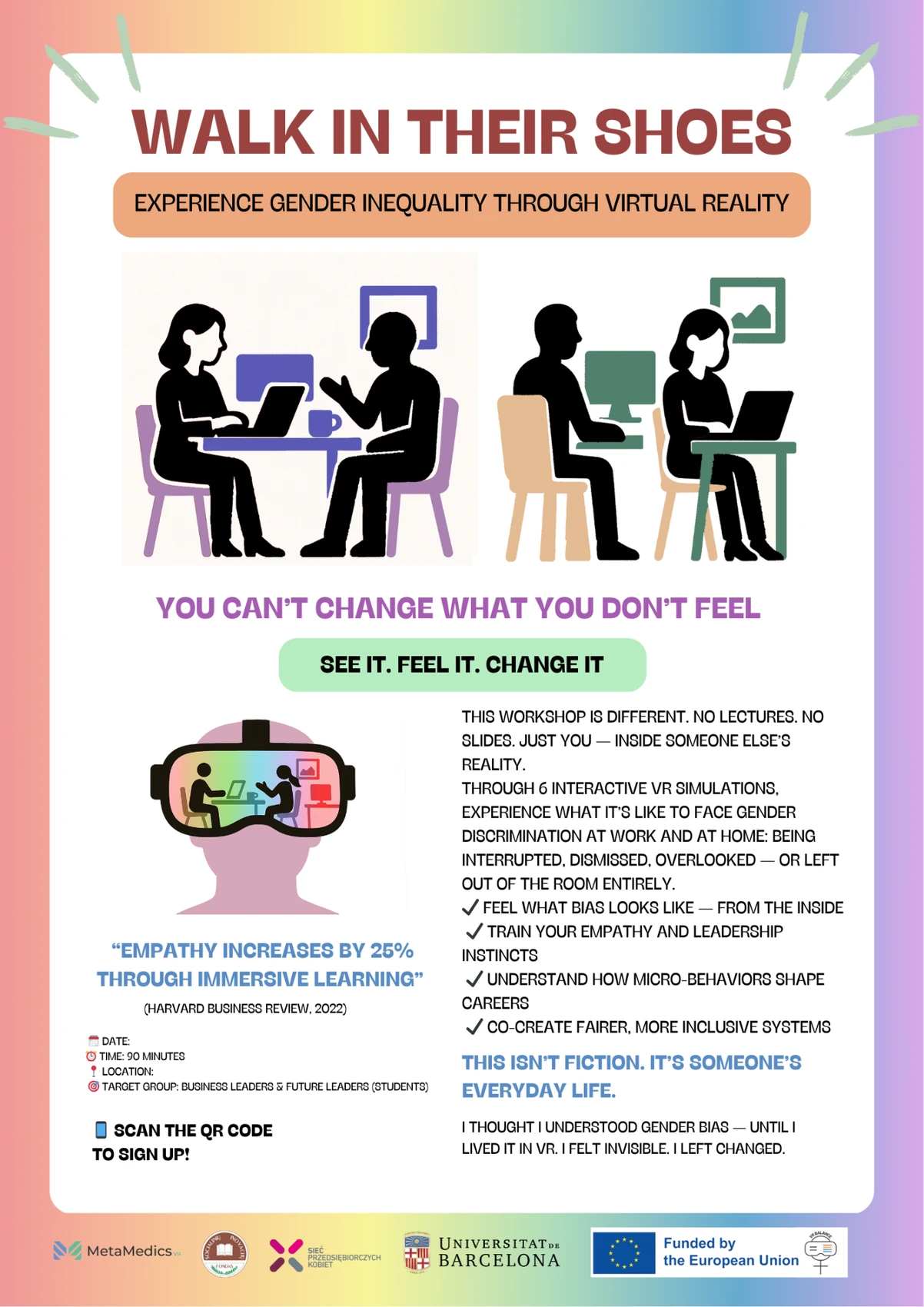
No lectures. Just you — inside someone else's reality. Through 6 interactive VR simulations, experience what it's like to face gender discrimination at work and at home.
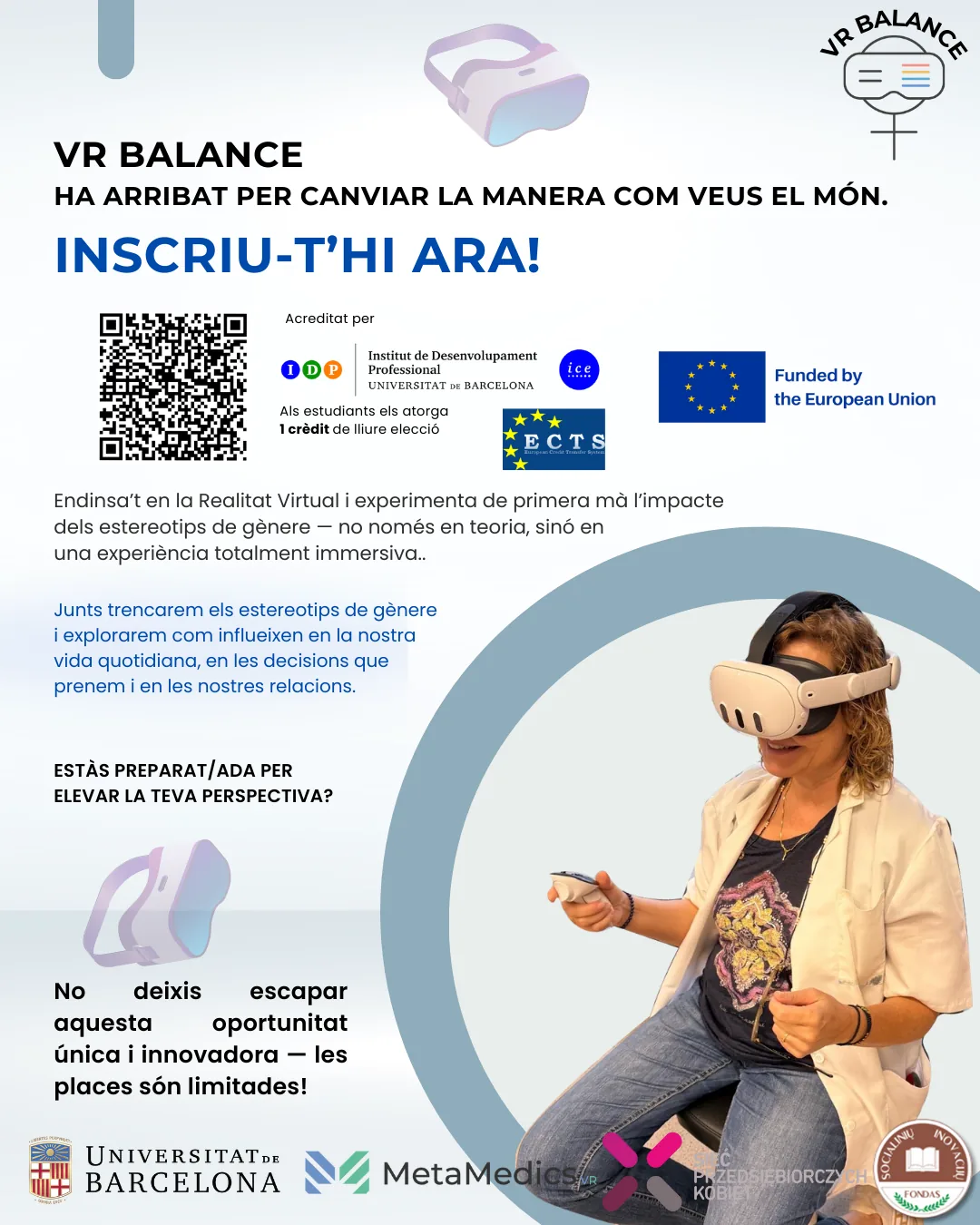
Dive into Virtual Reality and experience firsthand the impact of gender stereotypes — not just in theory, but in a fully immersive experience.
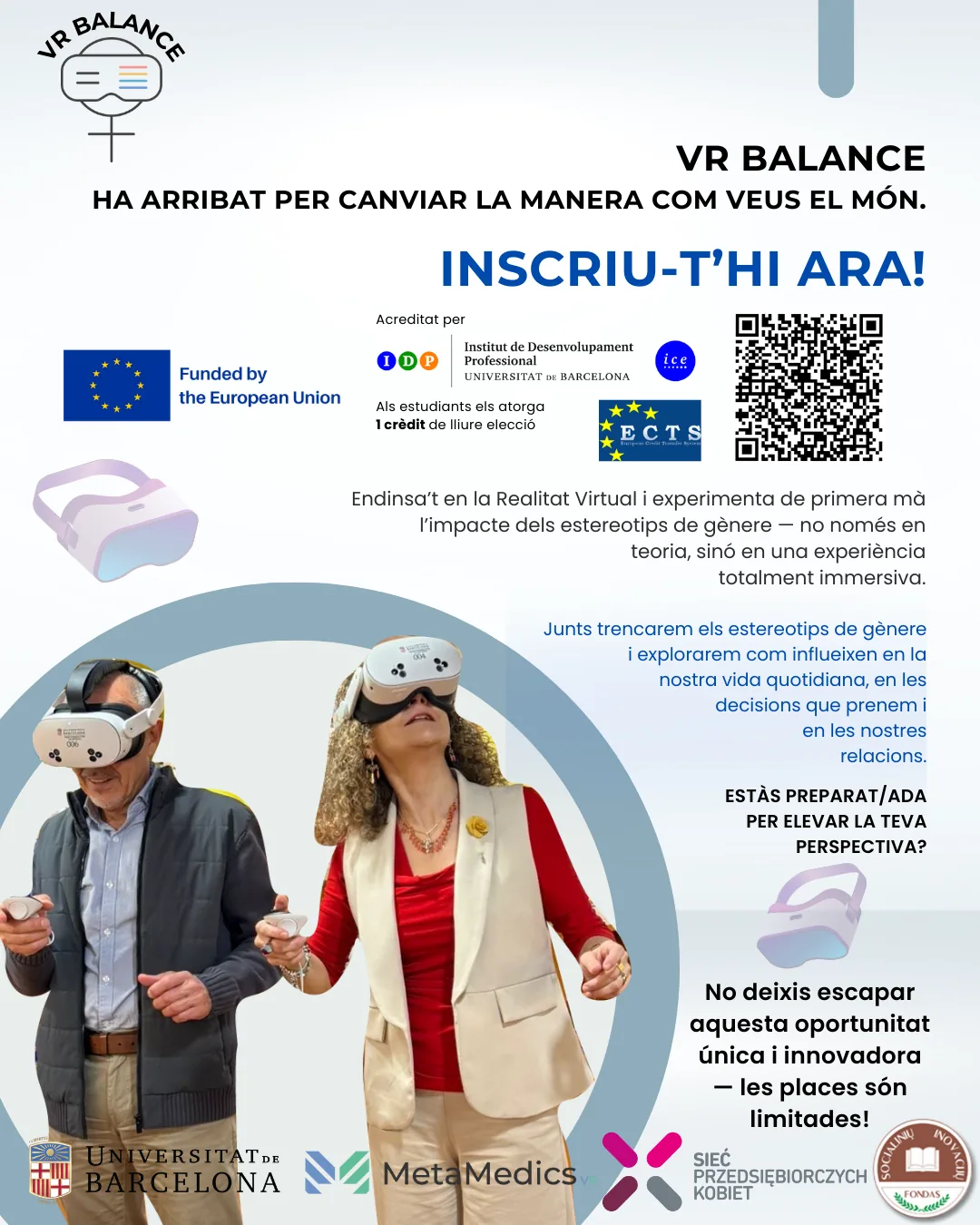
Together we will break gender stereotypes and explore how they influence our daily lives, the decisions we make, and our relationships.
VR Balance uses immersive technology to challenge perspectives, bringing together academic rigor and technological innovation.